

Beth Moore Deconstructed, and Here’s Where She Fell Short
The Quiet Expectation that Deconstructing Should Lead Back to Church

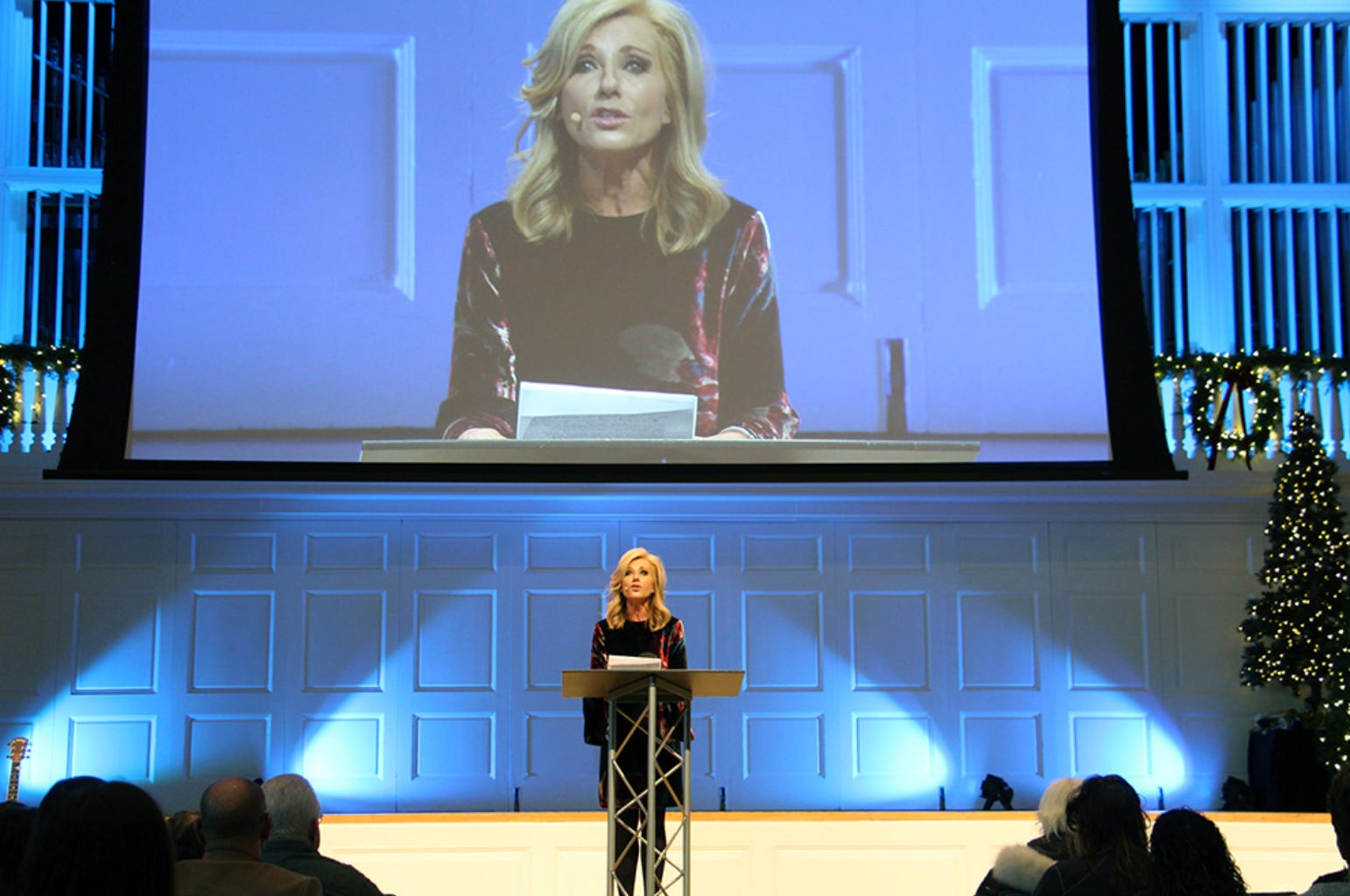
Beth Moore just had a way about her.
She told funny stories. She wasn’t afraid to be real, honest, broken. She felt safe and relatable, unlike other Southern Baptist preachers. Those were my thoughts as I sat high up in the bleachers of the auditorium, squeezed in between other women. All of us sitting with our notebooks and Bibles in our laps, listening to “The Word” being preached by this beautiful woman on stage.
This was in the late 90s/early 2000s, and Beth Moore’s name and teachings were everywhere, in the books she wrote, the teaching series she released on CDs, and in person at tour stops like this one in Indianapolis
My journey to Beth actually runs through Joyce Meyer.
For several years, if Joyce Meyer was within 90 miles of me, I was there. It was at one of these conferences that I was introduced to an up-and-coming preacher, Brian Houston, along with the Hillsong Worship band. I’ll reserve my thoughts about Houston and Hillsong in an upcoming writing.
Although I had followed Meyer for years, after her last conference that I attended, her influence over me began to wane. Her husband, Dave, had begun to preach. Many in attendance mumbled under their breath about this. To put it simply, Dave wasn’t Joyce. His delivery was dry and personalityless, and he liked to hammer home points already ingrained in our heads about obedience, submission, and repentance.
“If we wanted a sermon by a boring, white man, we would have been in church, Mister.”
I mean, at least I’m being honest, right? That’s how many of us felt when Joyce started to signal that Dave was going to take the stage. But my disdain for his preaching went deeper than just “another white man preaching to a bored congregation.” I hated, I mean, hated, his setup—the intro video they played before he took the stage.
Choppy in its style to appear urgent and real, it did nothing to convince me the scenes flashing before us on the big screen were indicative of a world “going to hell.” College students partying on the beach, video clips of the Vegas strip, clips outside abortion clinics, and shots of war were just a few of the images flashed in clips and antiquated colors to appear as if they were authentic newsclips from around the nation.
My first thought was always, “Why always with the war thing, as if its existence alone indicates the devil was creating chaos. Ummm—the Crusades called, and would like a word with Christians.” (I was sassy even then and apparently deconstructing without knowing it.)
But in the end, it wasn’t the war, Vegas, partying on the beach, or abortion clinic clips in Dave Meyer’s video that signaled my impending divorce from Joyce. It was the clips in that video that showed Pride parades with people smiling, laughing, hugging one another, proud to be free to express themselves openly and safely.
That did it for me.
I remember the last time I saw Dave’s intro video. Each version of his video became increasingly judgmental and agitating. This time, I had dragged my daughter and her friends to this conference, and I felt the weight of the moment. Sitting here with young women who admired my open-mindedness and wisdom, we were watching video clips in which they or one of their friends had no doubt been in similar situations.
And Dave was about to tell us how it was all proof that America had turned its back on God.
One of those women would eventually come out. I was one of the first people they felt safe enough to tell. I cringe to think that, had I not deconstructed and done it openly, I wouldn’t have been seen as a safe lifeline for the world they were about to step fully into.
Enter Beth Moore
Like I said at the beginning of this writing, Beth just had a way about her. After leaving Joyce Meyer, she felt modern, open-minded, and a breath of fresh air. In the end, however, Joyce, Beth, not even Priscilla Shirer, or Lisa Bevere—none of them were enough to keep me chained to a Christianity that was suffocating me.
It has been years since I thought about any of these women. When Beth left the Southern Baptist Convention, I took notice, as did many in the evangelical Christian world. She parted ways with the SBC because of Trump’s behavior toward women, including the now infamous “grab em’ by the p*ssy” that polarized Christians between those who saw this as the moment they could no longer support him (like Beth), and those who doubled down to declare “He can grab me by the p*ssy any time he wants,” and other disgusting reactions.
The truth is, Beth should have left the Southern Baptist church decades ago. SBC leadership’s disdain for her was thinly veiled. After all, women can’t be preachers, and there is very little upward mobility inside the SBC for women. Beth walked a fine line between teaching and not being seen as a threat to the men in leadership.
But let’s be honest, the most fragile of leadership can be found in spaces where white Christian men are threatened by a competent, confident, talented woman.
SBC leadership is no exception, and in 2019, when she commented on a Twitter post that she would be preaching on a Sunday, the clash between Beth Moore and the men in leadership came to a head. Major voices in the Southern Baptist Convention—including the president of Southern Baptist Theological Seminary and megachurch ultra-conservative/controversial pastor John MacArthur (who infamously told her to “go home!” to much applause) put out statements condemning Beth for violating God’s intent that preaching voices should be “a male voice.” A pastor in Georgia urged Lifeway, Moore’s long-time partner that carried her books and study series, to cancel their contract with her.
Beth was left reeling, desperately trying to reconcile how the church of her heritage, the one she protected vehemently and loved passionately, had put her squarely in their cross-hairs and decided that her worth would be determined by her willingness to openly apologize and submit to church authority.
The church that she had watched attack Bill Clinton for his predatory behavior, but was now defending a man who held no beliefs of the SBC or upheld the theological framework so ingrained in SBC church members.
She lost contracts; followers disappeared; sales plummeted. She was brutally attacked by women, because say it with me…
There is nothing more dangerous than a white Christian woman who will carry water for the patriarchy.
It all proved too much. In 2021, Moore formally left the Southern Baptist Convention, stating she could no longer identify with aspects of its “culture and public witness,” while still expressing love for many individuals within it.
And bookmark this part, because we’re coming back to it—despite leaving the SBC, she has said she still aligns with many of its theological beliefs and continues to identify broadly with her “Baptist roots.” She joined an Anglican church, marking a denominational shift but not a departure from Christianity or commitment to biblical teaching. In an article from April 2026, Moore stated that the idea of “quitting Jesus” has never been a consideration for her and describes herself as deeply devoted to Christ.
She has spoken about the emotional difficulty of leaving the SBC, describing it as a loss of a lifelong community and a struggle to find belonging afterward—a struggle that many of us who left our Christian heritage know oh so well. Pure and simple, it’s grief. It’s a loss of identity. It’s feeling like the ground underneath doesn’t support you anymore.
But did it ever, really?
The answer to that question will be different for many of us. I can’t help but feel compassion toward Beth’s journey. Many of us will recognize elements of our stories within hers. She shared in a 2021 article announcing her departure from the SBC that, in 2019, she no longer felt welcome within the SBC community.
Oh, how many of us know that feeling as well, Beth.
Like standing out in the cold rain, standing on tiptoes to peek into the gathering of people, warmed by the fireplace, smiling and enjoying each other’s company. That kind of loneliness.
Still, and I want to be careful with this, because I do believe in religious freedom. The Constitution gives us the right to express our beliefs and to be in community with those who share our beliefs. But Beth also put herself squarely in the political discourse when she stated that her reason for leaving the SBC was Trump.
For me that is an important distinction: Beth didn’t leave the SBC because of their treatment of her. There is no doubt that she was being watched and scrutinized for how she obeyed scripture as interpreted by the SBC. She often mentioned that she is a teacher of women, although many men were often present at her conferences. She also repeatedly said she had no desire to become a pastor in the SBC. To be clear, that wasn’t even an option. But what she was saying was, “I am not a threat to the SBC male leadership.”
In the end, the second they had what they deemed was a clear violation of SBC rules, they pounced on her. As many of us experienced, our value was only in our obedience to Christian patriarchy. Once we express our disagreement, it’s only a matter of time before the tension rises, and the only option is to submit and be silent, or leave.
Beth left, but let’s revisit that place above that I asked you to bookmark – “despite leaving the SBC, she has said she still aligns with many of its theological beliefs and continues to identify broadly with her “Baptist roots.” She joined an Anglican church…”
Beth calls herself “pro-life from conception to the grave,” a deep proverbial line in the sand that clearly states her position on not only abortion but most likely MAID (medical assistance in dying). Beth even went so far as to express concern that Trump may appoint judges who were supportive of a woman’s right to an abortion.
Beth received a great deal of attention for being attacked by the SBC because of her support for women of sexual abuse, but this part of her advocacy and beliefs flew under the radar. Some may say this falls into the category of religious beliefs, and I would agree. But how much of what is happening surrounding Project 2025 does Beth actually support because of her holding onto her SBC beliefs?
What about the tremendous blow to the voting rights of Black and Brown Americans from SCOTUS recent decision on The Voting Rights Act?
What about the defunding of school lunch programs that ensure millions of children head to school each day hungry?
What about immigrants, whether undocumented or not, who are afraid to leave their homes for fear of being turned in by the neighbors who they thought were friends?
What about the pregnant 10-year old, a victim of violent sexual abuse, who cannot access an abortion in her state and whose parents are forced to seek care by traveling to another state?
What about……?
The list goes on and on.
I know nothing about the Anglican church, and more specifically about the church that Beth now calls home. A basic search says that they lean “conservative” with many churches believing the Bible is infallible. Some independent churches lean more progressive and are involved in advocacy work that isn’t just mission-trip driven. But given that Beth has openly admitted that leaving the SBC did not change one thing about what she believes, it’s safe to assume that she landed in a church that aligns with the beliefs that she has stated she still holds.
The Constitution absolutely gives her the right to do so, but I’ll be honest with you. Beth Moore is held up as a beacon for what deconstructing without leaving church looks like. She proclaims she’d “never” give up on Jesus. Good for her, if that works for her. I have discovered that my attempt to cordon off areas that I refused to deconstruct, or at least question, limited my transformation.
I’m not saying that deconstructing to become as I am—an unchurched former Christian—should be anyone’s end goal.
But I’m also not comfortable allowing a Christian to put a stop sign in front of the beliefs that still harm others, because with just a little time invested in understanding Beth’s story, it’s easy to conclude that had it not been for the “grab ‘em by the p*ssy” comment and Trump’s treatment of women being different…
Beth Moore would not have abandoned the SBC and would have been, as many “nice” Christians are, a silent supporter of Trump, telling us to “just love on everybody as Jesus does.”
I’m far enough in my deconstructing journey to be able to reflect on the many seasons of my life that led to who I am today. That includes being grateful for my time as a Joyce Meyer then Beth Moore devotee—that is until I wasn’t.
More importantly, I’m grateful that I untethered from the toxicity that I see so plainly now, especially the kind that taught me that I can be a judgmental person, convinced of my spiritual superiority, if I did it with a smile on my face and love in my heart.
And lastly, I’m grateful that I learned to never say never and pretend that deconstructing always points a person back to church.
It doesn’t.
It shouldn’t.
It should lead to something more authentic that includes advocacy for those harmed by the toxic side of Christianity.
Without that, no matter what church you lead, no matter how much you preach about the love of Jesus, or no matter what church you attend, it’s performative.
Resources:
Beth Moore on life after the SBC — and why she never could quit Jesus
https://religionnews.com/2026/04/10/beth-moore-still-cant-quit-jesus/
Bible teacher Beth Moore, splitting with Lifeway, says, ‘I am no longer a Southern Baptist’
https://religionnews.com/2021/03/09/bible-teacher-beth-moore-ends-partnership-with-lifeway-i-am-no-longer-a-southern-baptist/
Beth Moore on X @BethMooreLPM
Beth Moore and Joyce Meyer weren't part of my faith journey, but this was such a fascinating peek into that world! Thanks for the thoughtful commentary.
I understand the feeling in a general sense. As of November '24, I have not attended church on a regular basis, and when I go, it is in time for worship service. I was in a men's Sunday School class, and I was the lone liberal/ progressive in the class. The others leaned conservative, mostly believing that trump can do no wrong, and the Democrats can do no right. After the election in '24, I found that most of the church members voted for trump.
One day last year, while working on the job as a part-time custodian, a church friend talked to me, and she knew that I have not been attending church for some time. She asked me why I was not attending Sunday School, and my response was short but simple: Politics. She told me that an individual should follow one leader, and that leader is Jesus. She mentioned talking to the men's class teacher about politics, stating that there are subjects that should not be discussed in a Sunday School session. Still, she understood my position.
I still attend church at times, and I still love the people there, but it is not easy having fellowship with them; I know that all of them did not vote for trump, though.
I will end here.